
Saline solution: single-dose, 500 ml or 1 L, which format to choose?
Physiological serum exists in 5 ml single doses, in bottles of 100 to 250 ml, in 500 ml bottles and in 1-liter jugs. The choice does not come down simply to the volume needed: it is based on a trade-off between sterility and cost. The single-dose guarantees a sterile solution for every use, but it works out to be about five times more expensive per millilitre; the large format is economical but loses its sterility upon opening.
The four formats and what sets them apart
The 5 ml single-dose container
It is the individual, sealed, single-use pod. Its 0.9% sodium chloride solution % is sterile and preservative-free, making it suitable for both infants and adults. It is generally sold in boxes of 30 or 100 units. Its main advantage is the complete absence of risk of cross-contamination each dose is opened at the time of use and then discarded.
The 100 to 250 ml bottle
Intermediate format, often equipped with a tip adapted for a specific use — eyecup for the eye wash, nasal tip for rinsing nasal cavities. It is suitable for occasional or on-the-go use, and represents a good compromise for a family first-aid kit.
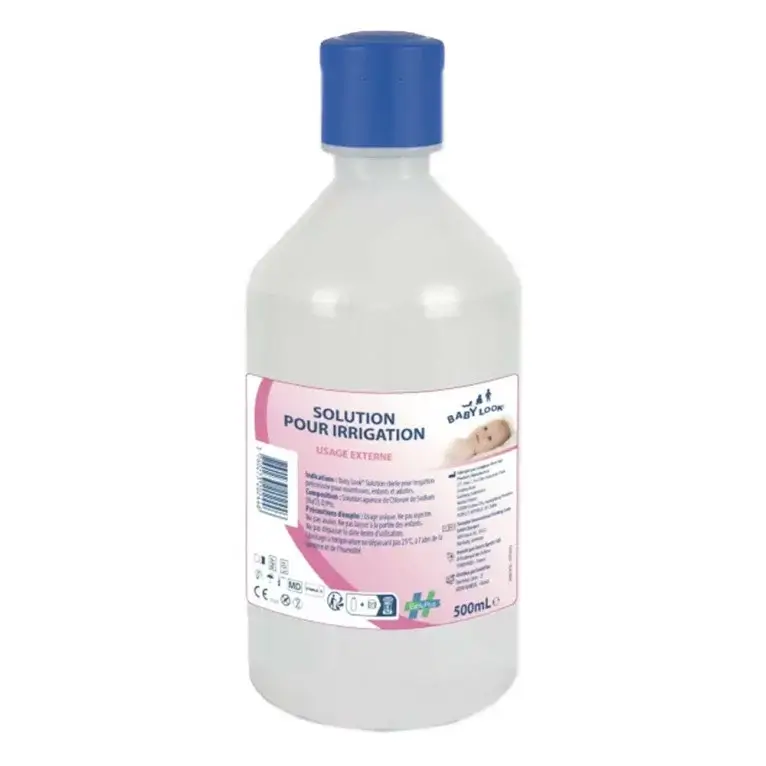
The 500 ml bottle
This is the most common format in workshops. It meets the needs of a family or regular home care without being bulky, while offering a cost per milliliter that is significantly lower than that of the single-dose.
The 1-liter container
Designed for heavy-duty use: nursing practices, nursing homes, laboratories, healthcare facilities. It offers the best volume-to-price ratio but imposes a constraint of storage and rigorous usage, since once opened it is exposed to contamination with each extraction.
The real decision criterion: sterility versus cost per milliliter
This is the point that most comparison tests gloss over. Saline solution is a simple product — water and salt — whose price is almost entirely determined by the packaging. The more the format guarantees sterility, the more expensive it is per milliliter.
Based on retail prices observed in pharmacies and specialized websites, the general range is as follows: a box of 30 single-dose units of 5 ml, for a total of 150 ml, sells for between €10 and €15, which puts the price per millilitre between 6 and 10 cents. A 250 ml bottle is priced around €3 to €5, or about 1 to 2 cents per millilitre.
The difference is therefore by a factor of about five. It does not reflect a difference in the quality of the solution — the formulation is identical — but rather the cost of individual packaging and unit sterilization.
The question to ask oneself is therefore not «which format is the best» but «do I need guaranteed sterility with every application». For a daily nasal wash in an infant, the answer is yes. For rinsing a countertop or moistening a compress, the answer is no.
Comparative table of formats
| Format | Sterility after opening | Usage type |
| Single dose 5 ml | Warranty, single use | Infant, eye, wound |
| 100–250 ml bottle | Limited, depending on the tip | Family kit, travel |
| 500 ml bottle | Refrigerate after opening | Regular home care |
| 1 L canister | Limited, repeated withdrawals | Doctor's office, nursing home, laboratory |
Which format for which use?
- Infant nasal washing: the single-dose unit is the standard format. It prevents any risk of contamination and can be handled with one hand.
- Eye care: choose single-dose or an eyewash bottle. The tip must never come into contact with the eye or eyelashes.
- Cleaning a superficial wound: normal saline is the product of choice for irrigation. It removes debris without harming the tissues, prior to the possible application of an antiseptic. The single-dose container makes it possible to create a jet with a simple squeeze.
- Regular family use: the 500 ml bottle offers the best balance between practicality and cost.
- Care facility: the 1-liter container is economically essential, provided strict hygiene rules are observed during sampling.
How long does each format keep after opening?
This is the point on which the available information diverges the most. Depending on the source, we read that an opened bottle can be kept for 24 hours, 15 days, or several weeks. This confusion stems from the fact that the duration depends on three factors: the packaging (presence or absence of a resealable tip), the possible presence of a preservative, and above all, the conditions of use.
The rule to remember is simple: the manufacturer's instructions are authoritative, and them alone. A bottle with a sterile closure system does not have the same duration of use as a bottle with a simple cap handled multiple times a day.
Three principles apply regardless of the product:
- A single-dose container cannot be stored. It is for single use only and must be discarded after application, even if some liquid remains.
- An opened multidose container must be closed immediately, stored away from light and moisture, and its tip must never touch the skin, the eye, or a wound.
- Storage is at room temperature, preferably below 25 °C. Refrigeration provides no benefit and is not recommended by the manufacturers.
In case of doubt—cloudy solution, contaminated container, expired shelf life—the product must be discarded. Since saline solution is inexpensive, there is never any point in taking a risk.
Building a comprehensive product range: the challenge for pharmacies and pharmacy groups
For a pharmacy or a pharmacy group, the question of format is not about the «best product,» but about range coverage. A patient coming in to get saline solution for their infant does not have the same need as a private-duty nurse. Offering both extremes—single-dose units and large volumes—makes it possible to meet all demand without sending the customer elsewhere.
Smart Agents Healthcare manufactures white-label saline solution in all of these formats: single-dose vials, 500 ml bottles, and 1-liter jugs, with fully customized packaging and labeling. Production complies with ISO 13485 standards and MDR 2017/745 regulation, with complete traceability of each batch.
→ Discover our private label saline solution offer
FAQ
Verified sources
• 5-ml single-dose vials, 0.9% NaCl %, preservative-free, boxes of 30 or 100: SMSP
• Observed prices (single doses €10–15 per box of 30; 250 ml bottle €3–5): Drexco Medical
• Usages by format (1 L professional, 500 ml family, 250 ml travel): Drexco Medical
• Store below 25 °C, do not refrigerate; tip must not touch the eye: Medisafe
• Saline solution for wound irrigation before antiseptic: Medisafe
• Divergence in retention periods between sources (24 hours / 15 days): Medisafe, SMSP, meilleurtest.fr