Hydrocolloid or foam dressing: what is the difference?
Hydrocolloid and foam dressings are two moist wound healing dressings that are often confused. However, their composition, absorption capacity, and indications differ clearly. Here is how to distinguish them in order to provide good advice and build a complete product range.
Two dressings, two mechanisms
Hydrocolloid and foam dressings share a common goal—maintaining a moist environment favorable to healing—but rely on distinct materials and mechanisms.
The hydrocolloid dressing
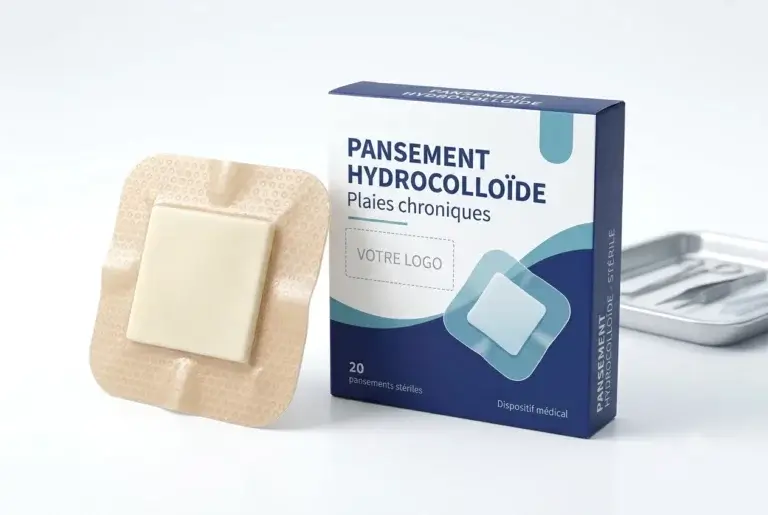
It is composed of hydrophilic particles (carboxymethylcellulose) in an adhesive layer. Upon contact with exudate, these particles form a gel. It is an occlusive dressing, suitable for lightly to moderately exuding wounds. It can absorb up to 3 times its weight in exudate.
The foam dressing
It consists of an absorbent foam, usually made of polyurethane, covered with an outer layer that is permeable to air and water vapor. It absorbs more while preventing excess moisture and limits adhesion to the wound. It is suitable for moderately to heavily exuding wounds.
Comparison table
| Criterion | Hydrocolloid | Foam dressing |
| Composition | Carboxymethylcellulose | Polyurethane foam |
| Mechanism | Forms a gel upon contact with exudate | Absorbs into the foam |
| Occlusiveness | Occlusive | Semi-permeable (breathable) |
| Exudate level | Low to moderately exudative | Moderately to heavily exuding |
| Types of indications | Superficial bedsores, low exudate ulcers | Ulcers, pressure sores, exudative burns |
| Holding in place | Up to 7 days | Up to 7 days |
How to choose according to the wound?
The determining criterion is the level of wound exudate:
- Low exudate wound, healthy wound edges → hydrocolloid, which maintains a controlled moist environment without maceration.
- Moderately to heavily exuding wound → foam dressing, more absorbent, to manage exudate without the risk of leakage.
- Very heavily exudative wound → direct towards a hydrofiber or an alginate, which are even more absorbent.
- Infected wound → neither: prefer a silver or charcoal dressing.
In any case, the wound must be cleaned with normal saline before application, and the final choice is up to the evaluation of a healthcare professional.
Offer both ranges as white label
For a pharmacy or a pharmacy group, having both types of dressings makes it possible to cover all chronic wounds encountered at the counter. It is also an opportunity to build a coherent healing range under its own brand.
Smart Agents Healthcare manufactures hydrocolloid dressings and foam dressings under private label, ISO 13485 and MDR 2017/745 certified, in sheet, thin, thick, and anatomical shapes. We support our partners from the definition of specifications to LPP registration.
FAQ
Verified sources
• Composition and mechanisms: Pharmazon, LD Medical, Securimed
• Exudate level and indications: Girod Medical, Walter Learning, VYV Équipement Médical
• Hydrofiber for heavy exudate: Securimed
• Selection by type of wound: VYV Équipement Médical (2025)